Japanese Wabori: Symbolism and “Breaking the Rules”
As a disclaimer, it should be understood from the onset that I am not claiming to be any tebori master or expert, nor am I cosplaying as one. I do not speak Japanese and have never undergone a traditional tebori apprenticeship. I use machines to do my tattooing (even pens now).
I received my tattoo name, Horinawa, not through some sacred lineage transfer from master to student—with saké and burning incense—but from a table of fairly-toasted Japanese tattooists at an Osaka tattoo convention afterparty in 2014. There are plenty of legitimate Japanese tattoo authorities in the world if you want to seek one out. I’m just an honest enthusiast for this stuff, likely like most of you, so I’ll try to share a couple of things I’ve learned over the last few decades.
In Shodo, the “way of writing” (the art and practice of Japanese calligraphy), it takes years of practice and study to develop skill and style to the point of mastery. Shodoka, calligraphy experts, stylize and embellish kanji in dynamic moments of spirit-infused inspiration.
A development occurred in the Meiji era, as observed by Nakabayashi Gochico, when poorly refined “wild-fox calligraphers” began splashing sumi letters across paper and trying to pass these off as zen masterpieces. These scribblers lacked the foundational work to be considered masters and were largely disregarded by properly educated calligraphers.
“We are artists, aren’t we supposed to break the rules?” I remember being asked this by Titine Leu, after attending a seminar on Japanese wabori symbolism, presented by Gomineko Books in Montreal. While trying to navigate this with as much tact and respect as I could muster at the time, I responded:
“I think we should probably know the rules before we try to break them… kind of like learning to walk before trying to run?”
I had seen many people attempting to breakdance before learning to crawl in the tattoo scene. Hell, I had actually been one myself. When my finances and networking finally allowed, I figured it was time to get a little educated, filling in the holes that were left during my apprenticeship.
In 1992, before the internet was even a thing, at my mentor’s shop in the middle of Canada, he had a single book on wabori—”The Japanese Tattoo” by Sandi Feldman. I pored over this book so many times, amazed at the sheer volume of work these people were getting. This book is still fairly epic as a moment in tattoo time and remains affordable online. I tried to glean as much information as I could from the limited prints and descriptions. I knew there were rules and symbolism to this style, but the idea of ever gaining any real depth of knowledge on Japanese tattoo principles from the other side of the planet was a pipe dream at the time.
Traditional Japanese tattooing always had an element of narrative or storytelling incorporated into it. This has likely been part of the mystique to those of us not “initiated” into the culture. Aspects of religion, cultural identity, and even underworld lifestyle have been expressed by the main content and accompanying imagery—but you would not know this if you were not privy to the message the image hides.
Maybe 15 years ago, after grilling another of my tattoo heroes online about traditional symbolism, Mike Dorsey told me, “Just make a pretty picture, man. That’s our job”. I laughed out loud and took his word at the time. I still tried to learn what I could but, for the most part, continued to offer whatever mismatched imagery my clients were asking for. I lived in Saskatoon, not Tokyo, after all.
For tattoo artists here in the West, if we understood a little more about the symbolism behind ANY of the content that we choose, let alone just Japanese images, we could help develop a concept into a symbolic image for our clients. This would literally bring tattooing back to its shamanic or totemic roots, embedding a principle permanently into the skin.
Business-wise, during a consultation, being able to sit down and discuss supporting symbolic stories or background information for any given image can be the deciding factor between a client getting that tattoo by you or the person down the street.
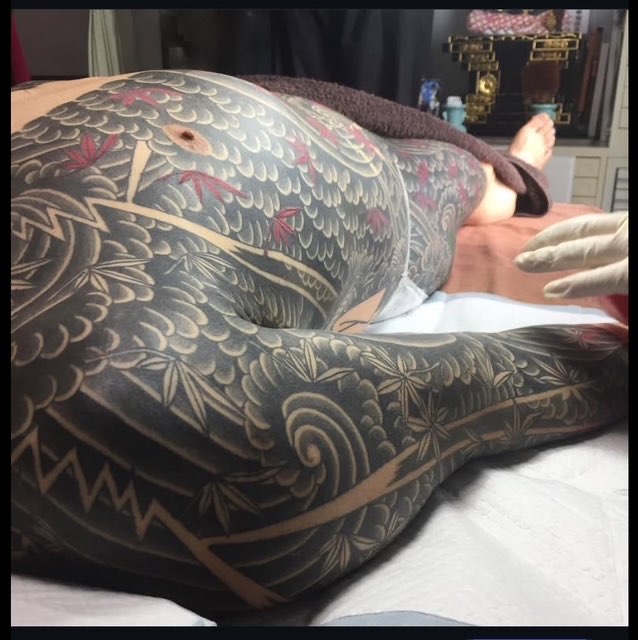
When going to an old-school Japanese Horishi (literally “carving-man”, or tattoo master), the basic starting point was once a consultation towards a full back or Kame-no-Kou, which translates to “turtle shell back and thighs”. Smaller “one-point” tattooing was not the norm for these men; significant commitment and coverage were expected from the onset.
It was originally considered standard to duplicate Ukiyo-e woodblock prints as the main image for the full back piece. Heroes, gods, and mythical creatures all represented options for the main image, usually representing different characteristics that either the wearer already possessed or hoped to acquire.
The main image choice would then establish the theme for any of the Gakubori (accompanying background around the main image). The Gakubori background could incorporate waves, waterfalls, clouds, cyclones, windbars, rocks, or flowers. The content and background for the back and thighs usually decreed what the leg layout would include. The content for any future sleeves was typically decided by what images were chosen for the chest panels.
If the goal was eventually a full bodysuit, trying to adhere to some consistency throughout the entire layout was important. Season could be one consideration, as it made no sense to have falling autumn leaves contrasted with spring blossoms. Also, certain animals like snakes lie dormant during the spring seasons when blossoms fall, emerging in summer.
Different artists and lineages have slightly different interpretations of the symbolism associated with given themes, but there are some general introductory principles that seem to be fairly common in wabori.
Seasonal Symbolism:
- Spring often symbolized renewal, youthful vitality, beginnings, and is usually associated with sakura cherry blossoms or upstream swimming koi fish.
- Summer represented young adulthood, richness, passion, abundance, and is commonly associated with peony flowers and sometimes post-hibernation snakes.
- Autumn is a cooling season, reflecting maturity and contemplation, and is usually paired with maple leaves. Kitsune or downward swimming koi are common autumn themes.
- Winter is the age of contraction, symbolizing resilience, longevity, purity, and surviving hardship. Winter is often paired with chrysanthemum or bamboo, or plum blossoms, with tigers or cranes being possible central images.
(Dragons are usually considered timeless and elemental, so they aren’t tied strictly to any season.)
In Japanese esoteric Shingon Buddhism, the classical elements of earth, water, fire, air (wind), and space (ether) are deeply symbolic. In tattooing, this was no different. If a person wanted to include different classical elements into the background of a full body suit, earth and water elements were generally placed nearer the lower parts of the body. Wind and clouds elements were placed near the sky, closer to the head. Ether was reflected in any intentional negative space. Otherwise, consistent elements were also acceptable—a full bodysuit of waves or wind as background was common.
Elemental Meanings:
- Earth and rocks usually symbolize stability, solidity, structure, and endurance. Earth is the rooted element that may divert or change the course of where water flows.
- Water is symbolic of flow, adaptability, cohesion, and emotion. Crashing water can signify agitated emotions, while still waters can signify a calm temperament.
- Fire represents energy, transformation, will, or purification.
- Air or wind can represent movement, breath, thought, impermanence.
- Ether and Space, like zen practice, represents emptiness at the source of phenomena.
Lightning is most closely associated with the element of fire but also embodies characteristics of heavenly energy and divine wrath.
Unfortunately for the craftsmen of the old school Japanese body suit, the days of well-funded fraternity members lining up to penthouses and hidden studios, committing to body suit after bodysuit, seem to be a thing of the past. Government crackdowns on criminal fraternities, public disapproval of visible tattooing, and modern yakuza members choosing more discreet appearances have greatly reduced the market for large work such as this.
Modern times have seen many established traditional Horishi offering one-point tattoo mementos to foreign visitors to cover bills. Such is the way of popular progress as it overtakes underground traditions. What is trending often overshadows the timeless.
How much are we as Westerners obligated to honor the strict traditional rules of wabori? Well, we are not.
Without steady repeat clientele, wanting large-scale traditional bodysuits, North Americans or Europeans attempting to be “wabori purists” about the size and rules of their Japanese-style work is totally impractical. If we want to turn away good clients wanting snakes with cherry blossoms because it isn’t technically “proper”, I guess the shop down the street will thrive while we starve.
I still ended up being given a tattoo name in Osaka with my work being far from perfect, so when we travel there, they still recognize the reverence and appreciation we show for the art, despite being silly naive gaijin.
With the loss of large-scale business for traditional horishi, they may not have need for such a wide array of tattoo symbolism in their world either. If they have not passed on this information to the next generation of apprentices, we potentially stand to lose a portion of the tradition itself. It is so much deeper than just picking and sticking whatever, wherever. Perhaps if enough tattoo artists, collectors, and other historians can create a resurgence of interest in traditional tattoo symbolism, maybe together we can assist some folks from becoming the “wild-fox tattooers” of the future!
Thanks for reading!
Pat Horinawa
By the way, I plan on doing a regular column for anyone who may be interested in the symbolism found in wabori, or other common western tattoo motifs. Feel free to check out future writings about iconography and sacred intention in tattooing as well!